
How Does Ahrefs DR Compare to DA – A Guide
Ever wondered how to measure your website’s authority?
Two metrics dominate the SEO landscape: Ahrefs Domain Rating and Moz Domain Authority.
Both promise insights into your site’s ranking potential, but they work quite differently under the hood.
Let’s dive into what makes each tick and which one deserves a spot in your SEO toolkit.
What is Ahrefs Domain Rating (DR)
Ahrefs Domain Rating serves as a key metric for evaluating your website’s backlink profile strength.
It operates on a scale from 0 to 100, where higher values indicate stronger link authority.
Here’s the thing — DR focuses exclusively on unique referring domains and the quality of links pointing to your site.
This laser focus makes it particularly useful for link-building campaigns.
What sets DR apart is its real-time updates every 12 hours.
This means you can track changes in your backlink profile almost instantly (pretty neat, right?).
For example, if a high-authority site like TechCrunch links to your startup’s blog post, you’ll see that DR boost within hours rather than weeks.
This rapid feedback helps you understand which link-building efforts actually move the needle.
The calculation behind DR is refreshingly straightforward compared to other metrics.
It simply asks: how many quality domains link to you, and how strong are those domains themselves?
What is Moz Domain Authority (DA)
Moz Domain Authority takes a completely different approach to measuring website authority.
This metric uses over 40 factors to provide a comprehensive score ranging from 1 to 100.
Unlike DR’s narrow focus, DA incorporates various ranking signals including content quality, spam scores, domain age, and site structure.
Think of it as a more holistic health check for your domain.
The broader scope means DA can better predict overall ranking potential.
For instance, a news website with excellent content but moderate backlinks might score higher on DA than DR.
However, this complexity comes with trade-offs.
DA updates only monthly, which can leave you waiting for feedback on recent SEO efforts.
Plus, the exact calculation remains somewhat opaque compared to DR’s transparent methodology.
We’ve noticed that DA often aligns better with long-term SEO strategy since it considers factors beyond just links.
It’s particularly valuable when evaluating domains for acquisition or partnership opportunities.
Key differences between Ahrefs DR and Moz DA
Calculation methodology and factors
The fundamental difference lies in what each metric actually measures.
DR concentrates entirely on backlink strength, analyzing the quality and quantity of unique referring domains.
DA employs a machine learning algorithm that considers dozens of factors:
-
Link profile quality and diversity
-
Content relevance and freshness
-
Technical SEO elements
-
Domain age and history
-
Spam signals and penalties
This difference means a site could have high DR but low DA if it has strong backlinks but poor content quality.
Conversely, a well-optimized site with moderate links might show higher DA than DR.
For example, a local business with excellent on-page SEO and moderate local links might score DA 35 but DR 20.
Meanwhile, a link farm with purchased backlinks could show DR 40 but DA 15.
Update frequency and data freshness
Here’s where the two metrics really diverge in practical usage.
DR updates every 12 hours, providing near real-time tracking of your link profile changes.
DA updates monthly, which can feel like waiting for dial-up internet in today’s fast-paced SEO world.
This slower cadence means significant changes in your backlink profile won’t reflect in DA scores for weeks.
Actually, this difference affects how you use each metric.
DR works better for active link monitoring and immediate feedback on outreach campaigns.
DA serves better for quarterly reviews and long-term trend analysis.
Score distribution and scaling
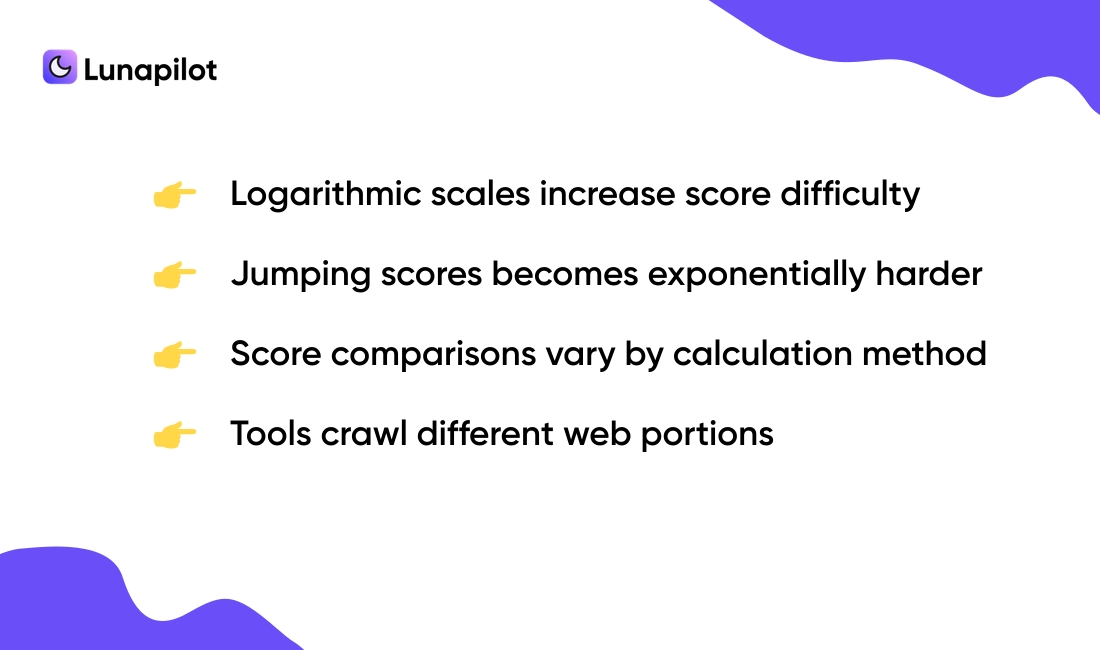
Both metrics use logarithmic scales, making higher scores increasingly difficult to achieve.
Moving from 20 to 30 requires far less effort than jumping from 70 to 80.
|
Score Range |
Difficulty Level |
Typical Site Type |
|---|---|---|
|
0-20 |
Easy to achieve |
New websites, small blogs |
|
21-40 |
Moderate effort |
Established businesses, niche sites |
|
41-60 |
Significant investment |
Industry leaders, popular brands |
|
61-100 |
Extremely challenging |
Major publications, tech giants |
The scores aren’t directly comparable between metrics.
A DR of 50 doesn’t equal a DA of 50 due to different calculation methods and data sources.
Plus, each tool crawls different portions of the web, leading to variations in their link databases.
This means you might see your DR and DA scores fluctuate independently based on which links each tool discovers.
Transparency and manipulation resistance
DR offers more transparent methodology since it focuses solely on backlinks.
You can easily understand why your score changed by examining new or lost referring domains.
However, this transparency makes DR more susceptible to manipulation through low-quality link schemes.
Some SEOs exploit this by purchasing cheap backlinks to inflate their DR scores artificially.
DA’s complex algorithm provides better manipulation resistance but less transparency.
The multiple factors make it harder to game, but also harder to understand why scores change.
Recent studies show both metrics can be inflated for as little as $15-$100 through questionable link-building tactics.
This highlights why you shouldn’t rely on either metric alone for important SEO decisions.
Read also: SEO for SaaS Companies: 6 Key Strategies to Implement – Lunapilot
Which is better for SEO – DR or DA
Well, the answer depends on your specific SEO goals and workflow.
Neither metric reigns supreme in all situations.
Choose DR when you’re focused on:
-
Link-building campaigns requiring real-time feedback
-
Competitor backlink analysis and prospecting
-
Quick assessment of link profile strength
-
Monitoring the immediate impact of new backlinks
DA works better for:
-
Comprehensive domain evaluation for acquisitions
-
Long-term SEO strategy planning
-
Holistic competitor analysis beyond just links
-
Quarterly performance reviews and reporting
Here’s the reality check — both metrics show weak correlation with actual Google rankings.
Recent research indicates DR correlates at just 0.14 and DA at 0.16 with search performance.
That’s pretty disappointing, honestly.
These numbers suggest that high DR or DA doesn’t guarantee ranking success.
We recommend using both metrics as directional indicators rather than definitive ranking predictors.
Combine them with actual traffic data, engagement metrics, and conversion rates for a complete picture.
For most SEO professionals, DR provides more actionable insights for day-to-day optimization.
But DA offers valuable context for broader strategic decisions.
Read also: What Is Topical Authority in SEO and Why It Matters – Lunapilot
Limitations and accuracy of DR and DA metrics
Let’s address the elephant in the room — both metrics have significant limitations that can mislead your SEO strategy.
The biggest issue? Can you trust a metric that’s easily manipulated?
Studies reveal that both DR and DA can be artificially inflated through cheap, low-quality backlinks.
Even more concerning, sites with zero organic traffic and Google penalties can maintain high authority scores.
This disconnect between metrics and actual performance creates a false sense of success.
Here are the key limitations to consider:
-
Weak ranking correlation – Neither metric strongly predicts Google rankings
-
Manipulation vulnerability – Both can be gamed with questionable tactics
-
Limited scope – They ignore crucial factors like user experience and content relevance
-
Database differences – Each tool crawls different portions of the web
DR’s narrow focus on backlinks misses technical SEO, content quality, and user signals that Google values.
Meanwhile, DA’s opacity makes it difficult to understand score changes or optimize effectively.
Actually, over-reliance on these metrics can harm your SEO efforts.
We’ve seen businesses chase high authority scores while neglecting user experience and content quality — the factors that actually drive rankings.
The smart approach combines authority metrics with performance data like organic traffic, click-through rates, and conversion metrics.
Use DR and DA as starting points for analysis, not final judgments on SEO success.
Remember, Google doesn’t use either metric in its ranking algorithm.
Focus on creating valuable content and earning natural links rather than gaming authority scores (trust us, it works better long-term).
Read also: Keyword Cannibalization: What It Is and How to Fix It – Lunapilot